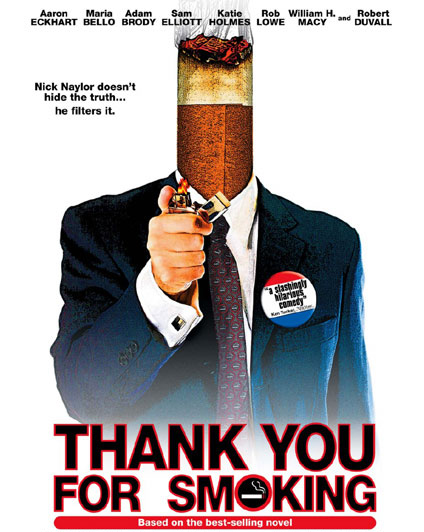
Here is
a satire both savage and elegant, a dagger instead of a
shotgun. "Thank You for Smoking" targets the pro-smoking
lobby with a dark appreciation of human nature. Nick Naylor
is a spokesman for the Academy of Tobacco Studies. We meet
him on "The Joan Lunden Show" sitting next to bald-headed
little Robin, a 15-year-old boy who is dying of cancer, "but
has stopped smoking." Nick rises smoothly to the challenge:
"It's in our best interests to keep Robin alive and
smoking," he explains. "The anti-smoking people want Robin
to die."
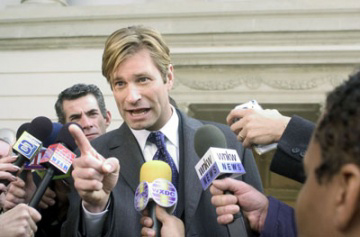
Nick is
a pleasant, good-looking career lobbyist who is divorced,
loves his son Joey, and speaks to the kid's class on career
day. "Please don't ruin my childhood," Joey pleads, but his
dad cross-examines a little girl whose mother says
cigarettes can kill you: "Is your mother a doctor?" Once a
week he dines with the MOD Squad, whose other members are
alcohol lobbyist Polly Bailey and firearms lobbyist Bobby
Jay Bliss. They argue over which of their products kills the
most people.
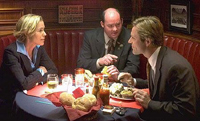 The
initials MOD stand for "Merchants of Death."
The
initials MOD stand for "Merchants of Death."
The
ancient Captain, czar of the tobacco industry, holds a cigar
like a threat in his own sneaky and subtle style: "I was in
Korea shooting Chinese in 1952. Now they're our best
customers. Next time we won't have to shoot so many of
them."
On the
other hand, Nick brings a certain detached logic to his
method: he is smiling, optimistic, and even trusting. Note
how he negotiates with a Hollywood super-agent on the
challenge of getting movie stars to smoke onscreen once
again. Right now, they agree, no one smokes in the movies
except for villains and Europeans. The stars would have to
smoke in historical pictures, since in a contemporary film
other people would always be asking them why they smoke. Or
-- why not in the future, after cigarettes are safe? Smoking
in a space station?
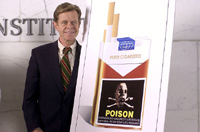 As
with any plausible corporate villain, Naylor has an opponent
in the film: Senator Ortolan Finistirre, a Vermont
environmentalist whose office desk is covered with his
collection of maple syrup bottles. The senator has
introduced legislation requiring a skull and crossbones to
be displayed on every cigarette pack, replacing the
government health warning. The symbol is better than the
words, he explains, because "they want those who do not
speak English to die."
As
with any plausible corporate villain, Naylor has an opponent
in the film: Senator Ortolan Finistirre, a Vermont
environmentalist whose office desk is covered with his
collection of maple syrup bottles. The senator has
introduced legislation requiring a skull and crossbones to
be displayed on every cigarette pack, replacing the
government health warning. The symbol is better than the
words, he explains, because "they want those who do not
speak English to die."
Should
the movie be angrier? I lost both of my parents to
cigarettes, but I doubt that more anger would improve it.
Everyone knows cigarettes can kill you, but they remain on
sale and raise billions of dollars in taxes. The target of
the movie is not so much tobacco as lobbying in general,
which along with advertising and spin-control makes a great
many evils palatable to the population. How can you tell
when something is not good for you? Because of the efforts
made to convince you it is harmless or beneficial.
 At
one point in the movie Nick pays a call on Lorne Lutch, a
former Marlboro Man, now dying of cancer and speaking out
bitterly against cigarettes. Nick brings along a briefcase
full of $100 bills. This is not a bribe, he explains. It is
a gift. Of course, to accept such a gift and then continue
to attack tobacco would be ungrateful. Lorne eyes the money
and wonders if he could maybe take half of it and cut back
on his attacks. Nick explains with genuine regret that it
doesn't work that way. Once you're on board, you're along
for the ride.
At
one point in the movie Nick pays a call on Lorne Lutch, a
former Marlboro Man, now dying of cancer and speaking out
bitterly against cigarettes. Nick brings along a briefcase
full of $100 bills. This is not a bribe, he explains. It is
a gift. Of course, to accept such a gift and then continue
to attack tobacco would be ungrateful. Lorne eyes the money
and wonders if he could maybe take half of it and cut back
on his attacks. Nick explains with genuine regret that it
doesn't work that way. Once you're on board, you're along
for the ride.
-Roger Ebert