 |
Public Choice:
by Ari Armstrong |
|
|
|
|
Colorado has 35 state senators. It has 65 state
representatives. Colorado also has 425 professional lobbyists, at least by my count (I lost track a couple of times and had to start grouping them by 50s), as listed on the Professional Lobbyist Report provided by the Secretary of State. That report is 104 pages long. So who, exactly, is writing the bills and running the state government? And why does it take four lobbyists to "help" every state legislator do his or her job? Jim Hughes of the Denver Post includes an exquisite quote in his January 31 story titled, "Empowered by vote, state Dems chased by lobbyists." He is discussing State Representative Kathleen Curry, a new Democrat from Gunnison. Hughes writes, "But she said she realizes the importance of lobbyists to the legislative process because lawmakers can't possibly master the full spectrum of issues they have to consider without help." Think about that for just a moment. If not even the legislators can "possibly master the full spectrum of issues they have to consider," how are the rest of us supposed to keep track? Indeed, how is any single person supposed to know what's going on in state government? People complain that politicians have hijacked government, which has become alienated from the people. But such a complaint doesn't capture the full magnitude of the problem: the government has become alienated from the legislators, too. And what's true at the state level is more true at the national level. Not only do members of Congress have the help of lobbyists, they also hire a professional staff to research the issues and correspond with constituents. Everybody who watches C-SPAN knows that the politicians hardly ever listen to the floor debate; instead, a member will often speak to a mostly empty room -- and to the cameras. True enough, the state legislature breaks into committees, and so the members of the committees probably know the particular bills they hear fairly well. That's what legislators told me for a story I wrote last year. However, when it comes to the floor vote, Representative Paul Weissmann said, "Very few people even read all the bills they vote on. It does take a lot of work." Indeed. And merely reading a bill hardly guarantees that one understands the underlying issues. Furthermore, no legislator who responded thought that many people -- including legislators -- had read Colorado's statutes. Sheriff Bill Masters argues that the sheer number of laws is the problem. Nobody, not the legislators, not those in law enforcement, and certainly not normal people, can understand the volumes of code that pass for law in Colorado. Jeffrey Friedman, editor of Critical Review, points out that people are generally ignorant of politics, and even the elites who think they know a lot about politics often substitute dogma for knowledge. The central problem is that people's lives are too complicated, and their knowledge is too dispersed and too often tacit, to be centrally planned. Rather than have a huge government that's impossible to manage and that therefore often produces unintended harms, we should restore a limited government that handles a few things well and that's simple enough for people to follow. But overly complex laws are only the proximate cause of our problems. What are the more fundamental causes? Of course the root cause is philosophical, as Ayn Rand argues, but I don't want to go that far back right now. Instead, I want to focus on the middle-range causes of the bloated state. To do this, I want to tell a few true stories. Recently my wife and I organized our photographs, so I have a couple of pictures to accompany the tale. Why are there so many lobbyists? What do they do, and why do they do it? In an article that was suggested to me by Ralph Shnelvar, Nora Stewart, herself a lobbyist (at least at the time she wrote the article), describes where the term "lobbyist" came from. I haven't verified her account through other sources, but it sounds plausible. She writes, "The term 'lobbyist' was coined by President Ulysses S. Grant in the Willard Hotel in Washington D.C. Every night when President Grant would sip on Cognac and smoke a cigar in the hotel lobby, people would line up and ask him for a bill, a favor, or for preferential treatment. It was due to the nightly ritual of people gathering in the lobby that Grant began to call them 'lobbyists.' It remains true today, as I often find myself in a lobby anticipating the arrival of a Representative or Senator so I too can ask for a bill, a favor, a hearing, or their help in passing or killing a bill." So that explains where the term came from, but why do lobbyists exist, beyond the obvious points that Stewart describes?
So of course I rushed to my boss and explained my findings, proud that I'd done my job and found wasteful spending to cut. My boss cast me a bored look and said something like, "Yes, but is the spending for Colorado in there?" You see, I had fundamentally misunderstood my job. I thought I was supposed to go through the budget and make sure the spending was justified. No, no, no. I was supposed to have gone through the budget to make sure that Colorado got its "fair" share of pork-barrel spending. And this was a Republican Senator, not some high-rolling liberal. Now, Hank Brown was a nice enough fellow, and, relatively, a pretty good politician. He even tried to take on the Amtrak monopoly, a project in which I was also involved. Yet it is common to hear Democrats and Republicans alike brag -- brag! -- that they are bringing home the bacon to their districts. Republican Congressman Bob Beauprez comes to mind as somebody who seems particularly proud to forcibly redistribute wealth to people in his district. For example, one news release states, "Congressman Bob Beauprez today announced funding for several important projects in and around Colorado's 7th Congressional District. The projects were included in the fiscal year 2005 Omnibus Appropriations Act that was passed over the weekend by the House and the Senate. The bill now goes to the President for his signature. 'I am pleased to have been able to secure these investments in our community and in our people,' said Beauprez. 'By investing in our infrastructure, our environment, our law enforcement and our children, we are helping secure a brighter future for the Denver Metro area'." But wait a minute, Bob. Aren't Republicans supposed to endorse federalism -- i.e., the notion that the powers of the national government should be limited, and the states or the people should take on the projects described in the release? Are we really better off when we send huge piles of money to politicians in Washington, D.C., and then watch those politicians wrangle over which groups end up with those dollars? (Minus all the handling fees, of course.)
Here's one of the basic theories popularized by the Public Choice school: the benefits of the redistribution of wealth are concentrated, whereas the costs are dispersed. Take as an example any subsidy, be it for rail transportation or corn. The beneficiaries of the subsidy are relatively small in number, and they get quite a lot of benefit from the subsidy. To make the numbers simple, let's say 1,000 people each pay $100 in taxes every year for the subsidy, and 10 people split the subsidy. That means each subsidized person gets $10,000 every year. However, because it takes some effort to pass the legislation and fight for and against the subsidy, the 1,000 people are, on net, poorer. That is, a few people are very much better off, but most people are a little worse off, by an amount of $100 plus whatever the transaction costs waste. The 990 people who pay the tax (but don't get the subsidy) have little incentive to fight it. A person could spend weeks of time fighting the tax and still lose. $100 just isn't worth days of lost labor and leisure time. The so-called "free-rider problem" also arises in this context: each of the tax payers will hope somebody else fights the tax, which means that nobody will fight it (or only a few will). Meanwhile, the 10 people who split the subsidy have a huge incentive to fight to keep the tax. They will come up with all sorts of rationalizations for why the tax is really a good idea. They will even persuade some among those who pay the tax. They will bully and bribe legislators. They will also hire lobbyists. They could pay somebody $10,000 every year to lobby the legislature, and still pocket $9,000 each. Concentrated benefits, dispersed costs. That basic theory goes a long way toward explaining why Colorado sports around four lobbyists for every legislator. It's about transferring wealth to special interests and handing out political favors. Now, it is true that some lobbyists try to fight the overall trends and defend free markets. The list of lobbyists includes friends of mine and allies on various political issues. So I'm not trying to paint all lobbyists with the same brush. However, I think it's fair to say that good lobbying is needed only because of all the bad lobbying. The theory that benefits are concentrated while costs are dispersed helps explain why Colorado still has the idiotic blue laws that ban the sale of alcohol on Sundays. Some owners of liquor stores want to maintain their monopoly on the sale of hard liquor and force a day of non-competition. Those are the concentrated benefits. The costs that are dispersed among hundreds of thousands of Coloradans are those of inconvenience and slightly higher prices. Individually, the costs are small, but collectively they outweigh the benefits of the economic protectionism. Why has government spending in the U.S. skyrocketed in recent decades? Frederic Bastiat explained the phenomenon in a pamphlet he wrote in 1850 titled The Law: "Men naturally rebel against the injustice of which they are victims. Thus, when plunder is organized by law for the profit of those who make the law, all the plundered classes try somehow to enter -- by peaceful or revolutionary means -- into the making of laws. According to their degree of enlightenment, these plundered classes may propose one of two entirely different purposes when they attempt to attain political power: Either they may wish to stop lawful plunder, or they may wish to share in it. Woe to the nation when this latter purpose prevails among the mass victims of lawful plunder when they, in turn, seize the power to make laws! Until that happens, the few practice lawful plunder upon the many, a common practice where the right to participate in the making of law is limited to a few persons. But then, participation in the making of law becomes universal. And then, men seek to balance their conflicting interests by universal plunder." Or, if you prefer Beauprez's pleasantly euphemistic phrase, the solution to universal plunder is to "secure these investments in our community and in our people." (Read the line with the emphasis on the word "our" and you'll get the right idea.) In a January 31 e-mail, Democratic State Senator Ken Gordon wrote, "If you are involved with higher education, or rely on Medicaid, or have a disabled child on a wait list for state services, or if you have children in large classes, or if you have a divorce case that has been waiting for a hearing for months, or if you are a policeman or firefighter whose pension is underfunded, or if you are a businessman who wants to have a good economic climate, or if you just want a healthy and prosperous state, come down to the Capitol to testify." Sure enough, Jim Tankersley reported for the February 3 Rocky Mountain News that "dozens of lobbyists and citizens testified about universities and poor people suffering from a lack of state funding in recent years." Concentrated benefits, dispersed costs. The perpetual battle over the spoils of plundered loot and economic protectionism also goes a long way toward explaining the hyper-complexity of the law, such that not even legislators really understand it. Yet I do not wish to press the point too far. We are not the playthings of economic forces beyond our control. Incentives matter, but they are not everything. As Bastiat suggests, an enlightened person can resist the progression toward universal plunder. The moral giants among us proclaim, "This subsidy that I receive is taken by force from those otherwise unwilling to pay it, and therefore it is unjust, and therefore I demand that it be repealed!" Though such people are rare, this fundamental political problem of concentrated benefits and dispersed costs is not insurmountable. Indeed, Bastiat had a pretty good idea over 150 years ago: "Away with the whims of governmental administrators, their socialized projects, their centralization, their tariffs, their government schools, their state religions, their free credit, their bank monopolies, their regulations, their restrictions, their equalization by taxation, and their pious moralizations! And now that the legislators and do-gooders have so futilely inflicted so many systems upon society, may they finally end where they should have begun... and try liberty..." |
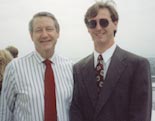 I learned an important lesson in 1992,
when I interned for Senator Hank Brown (pictured with me). One of the
staffers divided the budget among the interns. Each section of the budget
was an entire volume, and I ended up with transportation. As I started
looking through the budget, I began to notice strange-sounding entries for
"experimental" projects and the like. This looked suspicious to me. So I
marked all the odd-sounding additions I noticed, and it became apparent to
me that these expenses were added in the states of the Senators who sat on
the transportation committee. A-ha! Boondoggles! Pork-barrel spending! I
became more excited as I realized the amount of added spending was roughly
the same for every member of the committee. Except for the chairman, whose
state got more.
I learned an important lesson in 1992,
when I interned for Senator Hank Brown (pictured with me). One of the
staffers divided the budget among the interns. Each section of the budget
was an entire volume, and I ended up with transportation. As I started
looking through the budget, I began to notice strange-sounding entries for
"experimental" projects and the like. This looked suspicious to me. So I
marked all the odd-sounding additions I noticed, and it became apparent to
me that these expenses were added in the states of the Senators who sat on
the transportation committee. A-ha! Boondoggles! Pork-barrel spending! I
became more excited as I realized the amount of added spending was roughly
the same for every member of the committee. Except for the chairman, whose
state got more.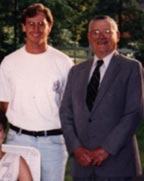 It was in 1995 when I spent a few
days with the Public Choice economists that I began to see the relationships
between pork-barrel spending, special interest groups, and lobbyists. (Nobel
economist James Buchanan is pictured to my right. Buchanan is one of the
founders of the Public Choice school.)
It was in 1995 when I spent a few
days with the Public Choice economists that I began to see the relationships
between pork-barrel spending, special interest groups, and lobbyists. (Nobel
economist James Buchanan is pictured to my right. Buchanan is one of the
founders of the Public Choice school.)