 |
It's Hard Out Here:
by Eamon Javers and Lorraine
Woellert |
|
|
|
|
Truth be told, there are few
smoke-filled rooms in Washington these days. The city council is set to
tighten its smoking ban, and Big Tobacco simply doesn't loom as large as it
once did. But the public view of billion-dollar deals in dark corners and
arm-twisting behind closed doors is about to get a Hollywood endorsement
with the Mar. 17 premiere of Thank You for Smoking, a gleeful lampoon of the
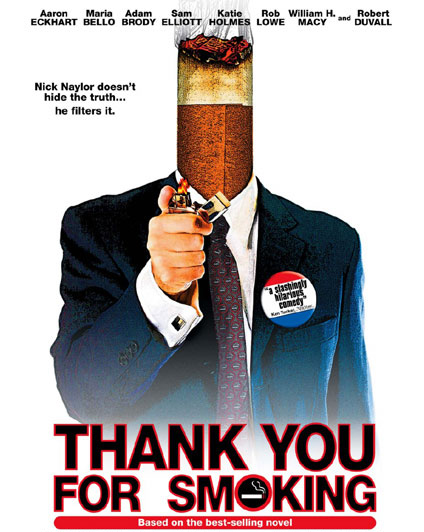
Beltway's culture of spin. Thank You's three amigos work for the alcohol, tobacco, and firearms industries and call their lunch bunch the M.O.D. Squad, for "Merchants of Death." The central character, menthol-smooth tobacco spokesman Nick Naylor, played by Aaron Eckhart, sets the scene with a simple observation: "This profession requires a moral flexibility that goes beyond most people." The real-life M.O.D. Squad doesn't have weekly lunches. But BusinessWeek assembled just such a group on Mar. 7 to ask: Do Sin Industry lobbyists lose sleep at night? First, the lobbyists -- who prowl Gucci Gulch and spin the press and the Hill on tobacco, guns, and booze -- screened the film. (One liquor lobbyist declined our invitation, fearing that his industry would be tarred by associating with...tobacco.) Then they dined at Washington power restaurant The Palm with Christopher Buckley, author of the 1994 book that inspired the movie. There, they reflected on their careers. The collective theme: It's hard out here for a lobbyist. The uproar over the illegal dealings of Washington influence peddler Jack Abramoff has drawn global attention to an industry that would rather duck and cover. Congress is contemplating new curbs on lobbying, and K Street is under assault as never before. "We've all been blamed for everything from smallpox to world hunger, so we're used to being attacked unfairly," says Chris W. Cox, chief lobbyist for the National Rifle Assn., who sports cufflinks emblazoned with the seal of his favorite government agency: The Bureau of Alcohol, Tobacco, Firearms and Explosives. At dinner, everyone imbibes, but no one lights up, and no one admits to packing heat. These Gucci Gulchers don't wear Gucci shoes -- the fine Italian leather can't hold up to long hours walking the corridors of power. And Rolexes? A digital Timex does the job. Over steak and cabernet, BusinessWeek's M.O.D. Squad pleads its case. Like Nick Naylor, the lobbyists say they're just earning a paycheck, defending legal products and the rights of Americans who smoke, drink, and own guns. Sure, they get confronted at cocktail parties, but "when you defend a civil right that's in the Constitution, it's a pretty easy argument," Cox says. And as you might expect from paid professionals, they know how to spin. Thomas H. Quinn, a partner at the law firm Venable LLP, whose long list of clients includes UST Public Affairs (UST ), an arm of the maker of Skoal and Copenhagen smokeless tobacco, makes a full frontal assault. No apologies here. "Lobbyist is the most noble profession," he says. "It used to be clergy and schoolteachers. But the highest calling is a lobbyist. The only business to protect the little man against the oppressive government is a lobbyist." Hollywood has a less flattering view, of course. Tinseltown's version of a lobbyist "sits astride a set of moral ambiguities and rides them like a water bug," says author Buckley. (Other Washingtonians in the film fare no better: Neither Katie Holmes, as a seductive reporter, nor William H. Macy, as an opportunistic senator, sets a high moral standard.) But his fellow diners don't see any hypocrisy in their work. "We wouldn't say it if we didn't believe it," says Drew Maloney, who has represented the trifecta of pariah products -- guns, booze, and tobacco -- over the years. At the end of the day, lobbying isn't all about wrapping your product in apple pie, God, and the flag. It's long hours, political maneuvering, and never forgetting the basic rules. First, "Never talk when a tape recorder is on," Quinn says into the tape recorder. "Never write anything down. Never talk on the telephone if you can talk face-to-face. And never talk if you can wink." Unlike Naylor, who in the movie takes a star turn before a Senate committee, real-life lobbyists work hard to avoid becoming public faces. When Congress calls, Big Tobacco, Alcohol, or Guns will send an industry executive, not a hired gun. But anyone who testifies must be coached in the cardinal rule, and that's where people like Quinn come in. "Never blurt out the truth," he tells clients. "Stick to the script. When you blurt out the truth, that's what gets everybody in trouble." Away from the witness table, lobbyists are relentlessly opportunistic. During the 2004 Presidential campaign, Senator John Kerry's handlers may have thought putting their candidate on TV with a shotgun and hunting gear would show voters that the candidate was a red-blooded American. The NRA immediately smelled blood -- and a way to push its agenda and favored candidate, President George W. Bush. Within 30 minutes of Kerry's foray into a goose pit in Ohio, Cox was on a plane to the state, where he held a press conference blasting the senator for posing with a shotgun that would have been banned by legislation the lawmaker had supported in Congress. Today, Kerry is back to being just another Democrat from Massachusetts. And the NRA? "Our approval ratings are higher than the President, the Democratic Party, and the Republican Party," Cox says. "Higher than the President and the Vice-President combined!" quips Quinn, a lifelong Democrat. Washington's population of lobbyists has doubled since 2000, an acknowledgement by Big Business of the ever-increasing power of Big Government, even in GOP hands. "I think it was [FedEx Corp. (FDX ) CEO] Fred Smith who said, 'I never worry about my competition putting me out of business, but I'll always worry about those bastards in Washington putting me out of business,"' says Cox. The head count for the Sin Industries, according to researchers at lobbyists.info: More than 60 button-holers, on staff with gun groups and companies as well as lobby firms, for firearms; almost 200 for beer, wine, and liquor; and 170-plus for tobacco. (The Tobacco Institute, which served as the model for Thank You's fictional Academy of Tobacco Studies, was forced to close up shop in the 1998 settlement of smoking lawsuits brought by the states.) Buckley's book, and the movie made from it, skewers exactly these types of Washington players. But he nonetheless sees the romance of it. "These guys get to have more fun than most other lobbyists," he says. "Who would you rather hang out with -- the people from the cancer society, or these guys?" Sure they're fun. But do they ever stop spinning? Even after four bottles of wine, the message is still exquisitely controlled. "Off the record, we'll have a really good conversation," says Quinn, pointing to a rolling tape recorder. "If this machine wasn't working I could really tell you something." |