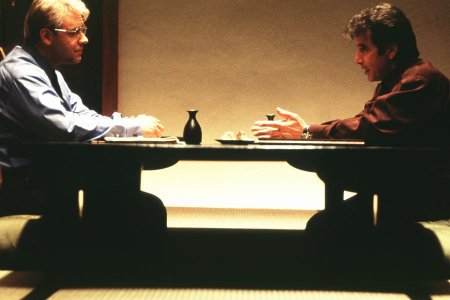
 Michael
Mann's "The Insider" makes a thriller and expose out of how big
tobacco's long-running tissue of lies was finally exposed by
investigative journalism. At its center stands Lowell Bergman, a
producer for "60 Minutes," the CBS News program where a former
tobacco scientist named Jeffrey Wigand spilled the beans. First
Bergman coaxes Wigand to talk. Then he works with reporter Mike
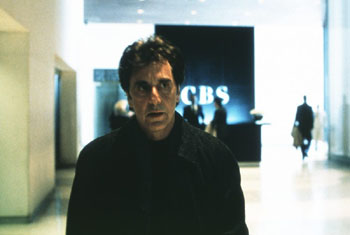
Wallace to get the story. Then he battles with CBS executives who
are afraid to run it--because a lawsuit could destroy the network.
He's a modern investigative hero, Woodward and Bernstein rolled into
one. Michael
Mann's "The Insider" makes a thriller and expose out of how big
tobacco's long-running tissue of lies was finally exposed by
investigative journalism. At its center stands Lowell Bergman, a
producer for "60 Minutes," the CBS News program where a former
tobacco scientist named Jeffrey Wigand spilled the beans. First
Bergman coaxes Wigand to talk. Then he works with reporter Mike
Wallace to get the story. Then he battles with CBS executives who
are afraid to run it--because a lawsuit could destroy the network.
He's a modern investigative hero, Woodward and Bernstein rolled into
one.
Or so the film tells it. The film is accurate in its broad strokes.
Wigand did indeed reveal secrets from the Brown & Williamson
laboratories that eventually led to a $246 billion settlement of
suits brought against the tobacco industry by all 50 states. "60
Minutes" did eventually air the story, after delays and
soul-searching. And reporting by the Wall Street Journal was
instrumental in easing the network's decision to air the piece.
But there are ways in which the film is misleading, according to a
helpful article in the magazine Brill's Content. Mike Wallace was
more of a fighter, less Bergman's puppet. "60 Minutes" executive
producer Don Hewitt didn't willingly cave in to corporate pressure,
but was powerless. The Wall Street Journal's coverage was not
manipulated by Bergman, but was independent (and won a Pulitzer
Prize). Bergman didn't mastermind a key Mississippi lawsuit or leak
a crucial deposition. And the tobacco industry did not necessarily
make death threats against Wigand (his former wife believes he put a
bullet in his mailbox himself).
 Do
these objections invalidate the message of the film? Not at all. And
they have no effect on its power to absorb, entertain and anger.
They go with the territory in a docudrama like this, in which
characters and narrative are manipulated to make the story stronger. Do
these objections invalidate the message of the film? Not at all. And
they have no effect on its power to absorb, entertain and anger.
They go with the territory in a docudrama like this, in which
characters and narrative are manipulated to make the story stronger.
The decision to center on the producer and go behind the scenes is a
good one because it allows the story to stand outside Wallace and
Hewitt and consider larger questions than tobacco. The movie
switches horses in midstream, moving from the story of a tobacco
cover-up to a crisis in journalistic ethics. Did CBS oppose the
story only because it feared a lawsuit, or were other factors
involved, such as the desire of executives to protect the price of
their stock as CBS was groomed for sale to Westinghouse? The movie
is constructed like a jigsaw puzzle in which various pieces keep
disappearing from the table. It begins when Bergman hires Jeffrey
Wigand as a consultant on another tobacco story. He learns that
Wigand possesses information from the tobacco industry not only
proving that nicotine is addictive (which the presidents of seven
cigarette companies had denied under oath before Congress), but that
additives were used to make it more addictive--and one of the
additives was a known carcinogen! Wigand has signed a
confidentiality agreement with B&W, and Bergman somehow has to get
around that promise if the truth is going to be revealed.
 Mann
is able to build suspense while suggesting what a long, slow,
frustrating process investigative journalism can be. Wigand dances
toward a disclosure, then away. Bergman works behind the scenes to
manipulate lawsuits and the coverage of the Wall Street Journal. He
hopes to leak parts of the story in truncated form so that he's free
to expose its full glory. Mike Wallace is beside him all the way,
finally zeroing in on Wigand in one of those interviews where
shocking statements are given little pools of silence to glisten in.
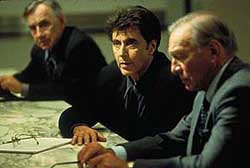
Then a corporate lawyer explains the law to the "60 Minutes" gang:
The more truthful Wigand's statements, the more damaging they are in
a lawsuit. "60 Minutes" boss Don Hewitt sides with the network, and
Bergman is blindsided when Wallace at first sides with Hewitt. Mann
is able to build suspense while suggesting what a long, slow,
frustrating process investigative journalism can be. Wigand dances
toward a disclosure, then away. Bergman works behind the scenes to
manipulate lawsuits and the coverage of the Wall Street Journal. He
hopes to leak parts of the story in truncated form so that he's free
to expose its full glory. Mike Wallace is beside him all the way,
finally zeroing in on Wigand in one of those interviews where
shocking statements are given little pools of silence to glisten in.
Then a corporate lawyer explains the law to the "60 Minutes" gang:
The more truthful Wigand's statements, the more damaging they are in
a lawsuit. "60 Minutes" boss Don Hewitt sides with the network, and
Bergman is blindsided when Wallace at first sides with Hewitt.
It's then that Bergman goes to work behind the scenes, leaking
information and making calls to competitors to blast the story lose
from legal constraints. And these are the scenes that owe the most
to Hollywood invention; the chronology is manipulated, and actions
of key players get confused. There is an underlying truth, however:
"60 Minutes" did eventually find a way to air its original story,
through the device of reporting about how it couldn't--a report that
had the effect of breaking the logjam. Mike Wallace's captures
that in a wonderful scene where Hewitt says the whole matter will
blow over in 15 minutes, and Wallace says, "No, that's fame. You get
15 minutes of fame. Infamy lasts a little longer."
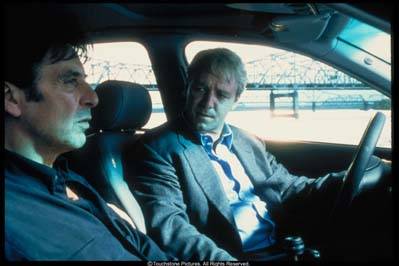 There
is a contradiction in a film about journalism that itself
manipulates the facts. My notion has always been that movies are not
the first place you look for facts, anyway. You attend a movie for
psychological truth, for emotion, for the heart of a story and not
its footnotes. In its broad strokes, "The Insider" is perfectly
accurate: Big tobacco lied, one man had damning information, skilled
journalism developed the story, intrigue helped blast it free. There
is a contradiction in a film about journalism that itself
manipulates the facts. My notion has always been that movies are not
the first place you look for facts, anyway. You attend a movie for
psychological truth, for emotion, for the heart of a story and not
its footnotes. In its broad strokes, "The Insider" is perfectly
accurate: Big tobacco lied, one man had damning information, skilled
journalism developed the story, intrigue helped blast it free.
-Roger Ebert
|
|
ASSIGNMENT
|
Consulting your textbook, notes, the
timeline of the film, and
the debate on CBC News, discuss and give your opinion on
public choice versus market solutions to externalities,
imperfect markets, and asymetric information.
Which do solution do you believe is more effective? Which is
more efficient? Why? Use the correct
economic vocabulary terms.
Write out your answers on the
AP
Macroeconomics Blackboard Discussion Board no later than
midnight Sunday, November 5. |
|
|
|
|
|
|
|
