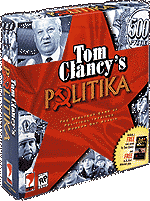
 Politika PolitikaTom Clancy's Game of Political Intrigue in Modern Day Russia Copyright (c) 1997 by Red Storm Entertainment. All rights reserved.
User Manual |
||||||
| Introduction
Politika is a game of strategy and negotiation for two to eight players. Each player represents a faction vying for political control of modern-day Russia after the death of President Putin. The goal of the game is to accumulate more influence - the support of the people and major institutions - than any other player after a specified number of turns; the winner will be elected to lead Russia into the 21st century. Politika is designed as a conversational game, meaning that as much emphasis is placed on the player's interactions with each other as on the player's interactions with the game. Making and breaking alliances, plotting with and betraying other factions, and keeping a watch on your own back are as important as the actions you take on your own. To succeed, you'll need to be as deft with the other players as you are with the dice. Starting the Game The first thing you will need to do is place your initial influence tokens - these token will be grouped by threes in each region on the board. Let the high roller begin, and each faction places one influence token in turn somewhere on the board until all the regions have three tokens. The first thing you will need to do (on your turn - check the status area) is place your representatives. To place a representative, click on a region. A representative will appear there. Remember that you can only place representatives in areas that are empty. Once all representatives are placed, the uprisings are placed automatically by the computer, and play begins. The Game Turn Every faction in its turn proceeds through five phases: Production, Movement, Trading, Challenge, and Buy Cards. Each phase lasts a certain amount of time; when time runs out or the player advances the phases using the Proceed button, the next phase automatically begins. Once a faction has completed its fifth phase, play passes to the next faction in line. When all factions have completed a turn, the next game round begins. Production During the production phase the production dialog pops up showing what regions produces for this turn, and who has influence in those regions. The indicator in each region shows what modifiers affect production (caused by Events and Uprisings). They are:
The total amount each faction earned this phase is shown, with the current faction highlighted in gold. If an event occurs, an event dialog pops up showing the event and how it affects the game. You can close this window by clicking the top left X button on the card. The active player automatically draws another production card. Movement During your turn you can move your pieces. To move a piece, click on it and drag it to the region you want to move it to. The region name will highlight in gold if the move is legal. Remember that you can move your two representatives and any uprising in which you have influence. If you have any cards that affect movement, you can play them at this time. Bring up the card window, select the appropriate card and press the Play Card button on the card. Click the Proceed button when finished, if the timer has not run out. Trading During this phase you can trade cards, influence, and money as well as set up alliances. During your trading phase, you can trade with any other player, and they can all trade with you; a dialog window will appear allowing you to select a faction to trade with. During someone else's trade phase, you can trade with that player only; any trading action will automatically involve the active player. * To trade a card, open the card window. Click on the Trade Card button at the bottom of the card window. * To trade influence, click the token on the board. * To trade money, open your money window and select the Transfer button at the bottom. * To offer an alliance, click on the peace symbol alliance icon. For all of these, a confirmation dialog will appear. Click the check box and the action will occur. You can also play any cards that affect trading or money at this time. If you play a Steal Money card, or are the Mafia, a dialog will pop up asking you whom you want to steal from. Select a faction and click the check box. Similarly, the KGB will get a dialog on their turn allowing them to steal a card from another faction. You cannot force another player to fulfill their side of a deal. In order to trade, one player must trust the other enough to actually transfer the item or funds; the other player can freely renege entirely or substitute lesser payment. Click the Proceed button when finished, if the timer has not run out. Challenges During this phase you can make challenges with both representatives and cards. The tokens that you can challenge show a yellow highlight. To begin a representative challenge, simply click on the token you wish to replace with your own. A challenge dialog will appear showing the attacker and defender's initial dice strengths. The attacker can click on the slider to buy additional dice, and click the check box to continue. Note that a similar dialog will come up on the defender's screen, so they will know that you are considering attacking them. Once you buy dice, you have committed to the challenge. It is now time to play any cards that you have that will help your challenge. If you have no cards you wish to play, click the check box. The defender will then have a chance to play any cards, and then can hit the check box in his status area. The dice in the challenge dialog will roll, and the results will be shown. Other players may view the current Challenge by clicking the Dice Icon in the status area; it will light when a challenge is underway. You can also play Regional Support cards at this time. If you play such a card, a dialog will come up asking you which faction you want to attack in that region. Select one, and it will continue into the challenge dialog as above. Click the Proceed button when finished with all challenges, if the timer has not run out. Buy Cards At the end of your turn a Buy Cards dialog will come up. You can click on the slider to select how many you want to buy (if any) and click the check box to purchase them. The Buy Cards phase is the final phase of the active player's turn. Play now proceeds to the next faction in line. Winning At the end of the number of rounds selected by the creator, the game will stop, and a dialog will pop up showing who has won. At this point, you can quit back to the lobby. Chat The chat window allows you talk with other players. Politika is a conversational game, so expect to spend the majority of your time playing this game using this feature. Like the chat area in the waiting screen, simply begin typing and your message will appear. When you hit return, chat will be sent. The colored bar or words at the center shows the current set of players that you will send and receive from; the first chat option, Global, automatically includes all players. You can select other sets of players (or private conversations) by clicking on the ( to bring up a menu. The second chat option allows you to selectively broadcast your chat messages. Select the players to receive your messages by clicking on their colors in the bar; this will toggle the faction squares between large and small. Colors that are large when a message is sent will receive the message. The third chat option, Alliance, automatically sends chat messages to your current ally. The final chat option, Eavesdrop, allows you to listen in on the private conversation of other players. Select the Eavesdrop option and then use the drop-down menu to select a faction upon which to spy. For the next minute, you will be able to read all the messages the target sends and receives. There is a chance that detected doing this, however, so be careful. Rules of the Game
Object of the Game Politika is a game of strategy and negotiation for three to eight players. Each player represents a faction vying for political control of modern-day Russia after the death of President Yeltsin. The goal of the game is to accumulate more influence - the support of the people and major institutions - than any other player after a specified number of rounds. Influence is measured in influence tokens. Each of the 23 regions on the game board holds three tokens. Each player begins the game with an equal number of tokens randomly placed on the board. Over the course of the game, players attempt to remove the tokens of other factions and replace them with their own. Game play normally lasts six rounds. At the end of the final round, players count their tokens. The player with the greatest number of tokens is declared the winner of the game and in control of the future of Russia. Playing Board The playing board of Politika is a map of modern-day Russia, which has been divided into 23 distinct regions. Each region contains three influence tokens at all times. These tokens represent political power within the regions. Each region has dots under the name, which represent its relative production value in dollars (rubles being worthless). Six dots indicates that it will appear six times in the production deck; one indicates that it will appear once. Six of the regions are tinted differently. These are the separatist regions, and are important to the Separatists faction (see below under Special Abilities). Pieces Each player has two pawns, or representatives, of the same color. These pieces represent the player's ability to gain political power. During every turn, each representative can move once and challenge once. Each player also has a collection of colored squares or influence tokens. They represent that player's political power within the regions and the uprisings. There are three uprising pieces that each hold three influence tokens. They represent areas of political unrest which players can try to control and use to block production in regions. They are called the bourgeois, labor and student uprisings. This is indicated by the , and respectively, on the piece. Starting the Game
The computer will automatically distribute and equal number of influence tokens and money to all factions, as well as determine the order in which the factions will play. The first faction places one of its two representatives on any region on the board. Proceeding through the faction order, each faction places a representative in any region not already containing a representative. When the last faction is reached, it places both representatives. Then placement continues backwards through the list, ending with the first player. Place Uprisings The computer will now place the three uprisings by drawing a production card and placing one uprising in each area indicated on the card. Play is now ready to begin. Playing the game Beginning with the first player, each faction in turn:
Production The computer will draw a production card for the active faction. Three regions of Russia are listed on each card; each faction receives $10,000 for every listed region in which it has at least one influence token. A faction does not receive extra money if it has more than one token in that space. Some production cards generate Events. An event card becomes effective immediately, and a new production card is drawn. Some events are immediate, while others last for one full round of play. Movement Factions may move two types of pieces on their turn: representatives, and any uprisings where they have influence. Representatives that start in regions where the faction has no influence may only move one region in any direction. Representatives that start in regions where the faction or its ally (see below, under Alliances) have some influence can be moved any number of spaces through regions which contain influence tokens of that faction's or ally's color, but then must stop once they reach a region where the faction has no influence. For example, if a faction had a representative in Kamchatka and no influence in that region, it could only move the representative to Sakha and Primorskiy. If, however, it had influence in all three regions, he could move the representative to Sakha, Primorskiy, Taymyria, Evenkia, Irkutsk or Chita. Representatives are moved by clicking and dragging the piece; regions to which the representative can move will be highlighted in gold as the cursor moves over them. Up to three representatives may share the same region. Factions may also move uprisings in which they have any influence. They may move each uprising one region in any direction for each influence token of their color in that piece, regardless of the influence the faction may have in those regions. However, uprisings may not move through regions already containing another uprising. Uprisings are moved by clicking and dragging the piece; regions to which the uprising can move will be highlighted in gold as the cursor moves over them. Only one uprising may be in a region at a time. Trade During the trading phase, the active faction may trade action cards, money and influence with the other faction - the rate of the exchange is determined by the players (players can give freely if they wish). Factions trade influence by changing one of their tokens on the board to one of the other faction's color. A faction may swap tokens with another faction as much as it likes, but may only give away one token without receiving a token in exchange once per turn. This is to prevent players from giving away all their tokens. Alliances During the trading phase, factions can also set up alliances. An alliance is indicated on the influence tokens themselves: a small dot of the ally's color will appear in the center of the owning faction's token. Players may only be in one alliance at a time; challenging an ally, or forming an alliance with another faction, will break the alliance. When an alliance is broken, the two former allies must re-establish the alliance during a trading phase. An ally's influence tokens act as your own for the purposes of defense and movement. A faction can move through spaces of ally control as if they were their own, and if attacked in a region containing ally tokens, those tokens add defensive dice. Challenges In a challenge, factions try to change one of the influence tokens in a region where they have a representative. The faction selects which token it wishes to change, and the active faction (the attacker) and the owner of that token (the defender) roll dice to determine the winner. Factions may perform one challenge with each of their two representatives. Challenges may not be shared; that is, one representative cannot perform two challenges while the other performs none. The Communist faction has a special ability that allows one of its representatives to make a free Challenge; see Special Abilities below. Challengers buy their dice, as many as they like, for $20,000 per die. Defenders receive one die for each token they have in that region. If they are in an alliance, they also receive one die for each token their ally has in that region. The order of challenges is:
Once the dice are rolled, each player totals theirs. If the challenger has the greatest total the target influence token is replaced with one of the challenger's color. Defenders win ties. Certain action cards allow players free challenges in specific regions. These must be played during their challenge phase, and, as with ordinary challenges, extra dice can be bought. Uprisings Uprisings are special pieces that factions can use to limit production. Any region containing an uprising does not produce any money. Factions can therefore move uprisings around and use them to block other factions' production. As mentioned above, a faction can move an uprising as many spaces in any direction as it has influence tokens in that uprising, but not through spaces that already contain another uprising. To try and control an uprising, you must have a representative in the same region as the uprising. The representative then makes a challenge against one of the influence tokens in the uprising, much as it would against the region itself. The tokens used to determine defensive dice are only the ones in the uprising, not the ones in the region. Buying cards In the final phase of the turn, the active faction can buy additional action cards. It may buy none if it wishes. Action cards cost $20,000 each ($40,000 if the inflation event card has come up). Special abilities As mentioned above, each faction has its own special ability. They are:
Special abilities are not transferable to allies. Ending the Game After the number of rounds chosen at the beginning of the game, factions compare the total number of influence counters they own, including those contained in uprisings. They then add one to this total for every $30,000 ($60,000 if inflation is in effect) they have, rounded down. The player with the greatest total is declared the winner. If two factions are tied, the influence counts of their allies are added to determine a winner. If there is still a tie, or the two top factions are allied, the game ends in a stalemate. Russia, lacking strong leadership, collapses. Copyright (c) 1997 Red Storm Entertainment All rights reserved |
||||||
Clancy Cup | Politika Patch | Rules | Screen Shots | Book | | Support | Home Home | Gamers' HQ | Corporate HQ | Press | Employment | Stormwatch | Shop |
||||||
|
Broken Link? Mail webmaster@redstorm.com |
||||||
Tom Clancy's Politika and all text and information on these pages are © Red Storm Entertainment, 1996-8. All rights reserved. |
||||||