Terrorism in West Africa
On the night of 14–15 April 2014, 276 female students
aged 12–15 were kidnapped from the
Government Secondary School in the town of Chibok in northern Nigeria. Boko
Haram, an Islamic Jihadist organization claimed responsibility for the
kidnappings. Boko Haram leader Abu-Bakr Shekau claimed that girls as
young as nine should be married instead of attending school and that he
intends to sell the girls into slavery in violation of international law.
United Nations Secretary-General Ban Ki-moon and UNICEF condemned the
abduction, and the Office of the U.N. High Commissioner for Human
Rights says the reported intention by Boko Haram to sell abducted girls as
slaves is a crime against humanity absolutely prohibited by the Universal
Declaration of Human Rights.
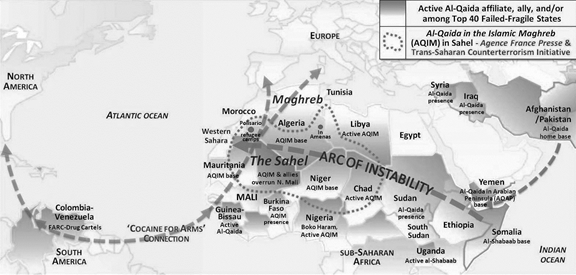
Boko Haram and other Islamic fundamentalist groups in Africa are opposed to
any form of "Westernization", and are believed to have been responsible for
more than 6,000 deaths in Northern Africa in the past 5 years. The Nigerian
government declared a state of emergency in May 2013 in its fight against
the insurgency, and the resulting crackdown combined with a French military
operation in Mali has led to the capture or killing of hundreds of Boko
Haram and Islamic Maghreb
members. However, the anti-insurgency campaigns have failed to stabilize the
situation with many terrorist groups across the African Sahel increasingly
targeting civilians while financing themselves through the international
drug trade and human trafficking.
Although Boko Haram does not currently possess the numbers or firepower
needed to overthrow the Nigerian government, there is fear that terrorist
groups operating in Africa such as Al Qaeda in the Islamic Maghreb
(AQIM)
and
Al-Shabab—with substantial funding from illegal activities and training and
weapons from countries such as Iran-- could unite and potentially
destabilize all of Northern Africa.
The Civil War in Syria
Syria’s human rights record and its pursuit of weapons of mass destruction
under the dictatorship of Bashir al-Assad has often been a concern of the
United Nations. With the changes in the country and the region following the
Arab Spring in early 2010, the UN led the way in an effort to engage with
Syria to reduce regional tensions and promote Middle East peace. However,
the Syrian government’s brutal response to nation-wide demonstrations
quickly descended into an armed conflict that has lasted three years, taken
more than 146,000 lives, and displaced nearly 9 million people within the
country and beyond its borders.
The Syrian government has
been given military support by
Russia and China, while
Iran,
Qatar,
Saudi Arabia,
Turkey, Great Britain, and the
United States have transferred weapons
and humanitarian aid to the rebels.
Based in Lebanon,
Hezbollah has entered the war in
support of the Syrian army while other Islamic fundamentalist groups such as
al-Qaeda, operating out of Iran and Iraq, are supporting the rebels. The
international response has created what may be a ‘proxy
war’ between
global powers.
However, a UN report has described the
conflict as being "overtly sectarian" between mostly
Alawite and
Shia government forces fighting against
Sunni-dominated
rebels.
Both
government and opposition forces have been accused of severe human rights
violations.
There have been reports of massacres,
widespread
torture
and terror, and the use of chemical and thermobaric weapons in violation of
the Geneva Convention.
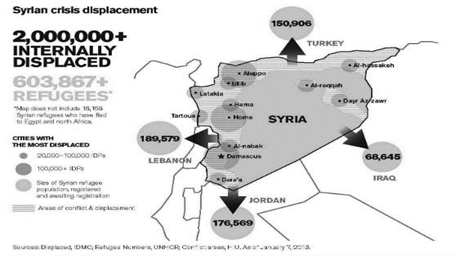
The severity of the humanitarian disaster
is illustrated by the four million Syrians, Palestinians, and Kurds who have
fled the country and become
refugees
in Lebanon, Jordan, and Iraq, with millions more left in poor living
conditions with shortages of food and drinking water. The situation is
especially bad in several refugee camps on the borders of Syria, where
residents are facing death by starvation.
The UN
remains deeply concerned by
the conflict and
has led the international community’s efforts to work towards a negotiated
political
solution to the conflict.
In
2014, Ukraine had experienced years of corruption and lack of economic
growth. Ukrainian President Yanukovych sought to attract investment capital
from the European Union (EU), but Russian President Vladimir Putin—fearing a
loss of influence in Ukraine--used threats and enticements to get the
Yanukovych to sign an economic treaty with Russia instead. A series of
violent protests against the treaty culminated in the ousting of Yanukovych,
and the installation of an interim government. Russia has accused the United
States and the EU of funding and directing the revolution, and has refused
to recognize the new government, threatening an oil and gas embargo on the
EU.
In the aftermath of the revolution, laws were passed by the interim
government outlawing the use of the Russian language and denying ethnic
Russians basic constitutional rights. Riots soon broke out in the Eastern
and Southern regions of Ukraine where
ethnic Russian
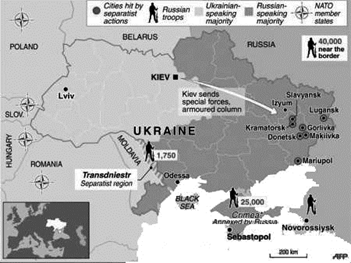
were a majority. Pro-Russian forces--widely believed to be undercover
Russian soldiers—took control of the Crimean peninsula, occupying Crimea's
parliament building
and calling for a referendum on Crimea's autonomy. In this
referendum, 96% of Crimean residents voted to join the Russian
Federation and the peninsula was quickly occupied by Russian military
forces. This vote has been
condemned by the EU, the US, Ukrainian and
Crimean Tatar
officials as contrary to Ukraine's constitution and international law,
particularly a 1994 treaty in which Russia pledged to respect Ukraine’s
borders. The United States and
the EU have initiated economic sanctions against Russia.
Russian President
Vladimir Putin
has stated his belief that the 1954 incorporation of Crimea into Ukraine
under the Soviet government was invalid, and declared he was protecting the
rights and property of ethnic Russians.
With Ukrainian military forces moving to control continued rioting in
Russian majority districts, Putin has again stated he will protect ethnic
Russians by any means necessary and massed Russian military forces along the
eastern border of Ukraine.